

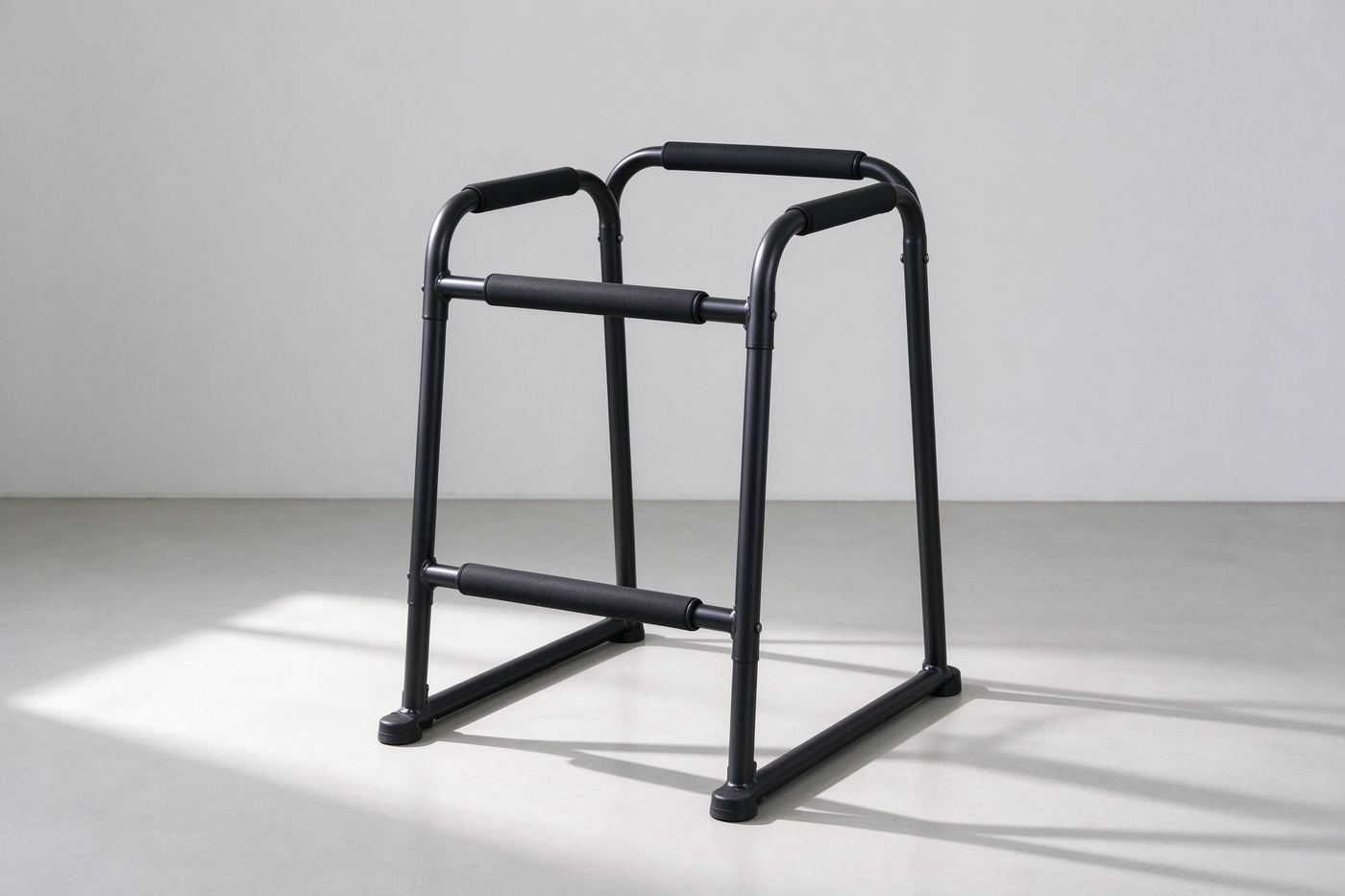
Furniture is not a handle.
The hard part of getting up is rarely strength on its own. It is having nothing solid to pull on at the moment you need it.
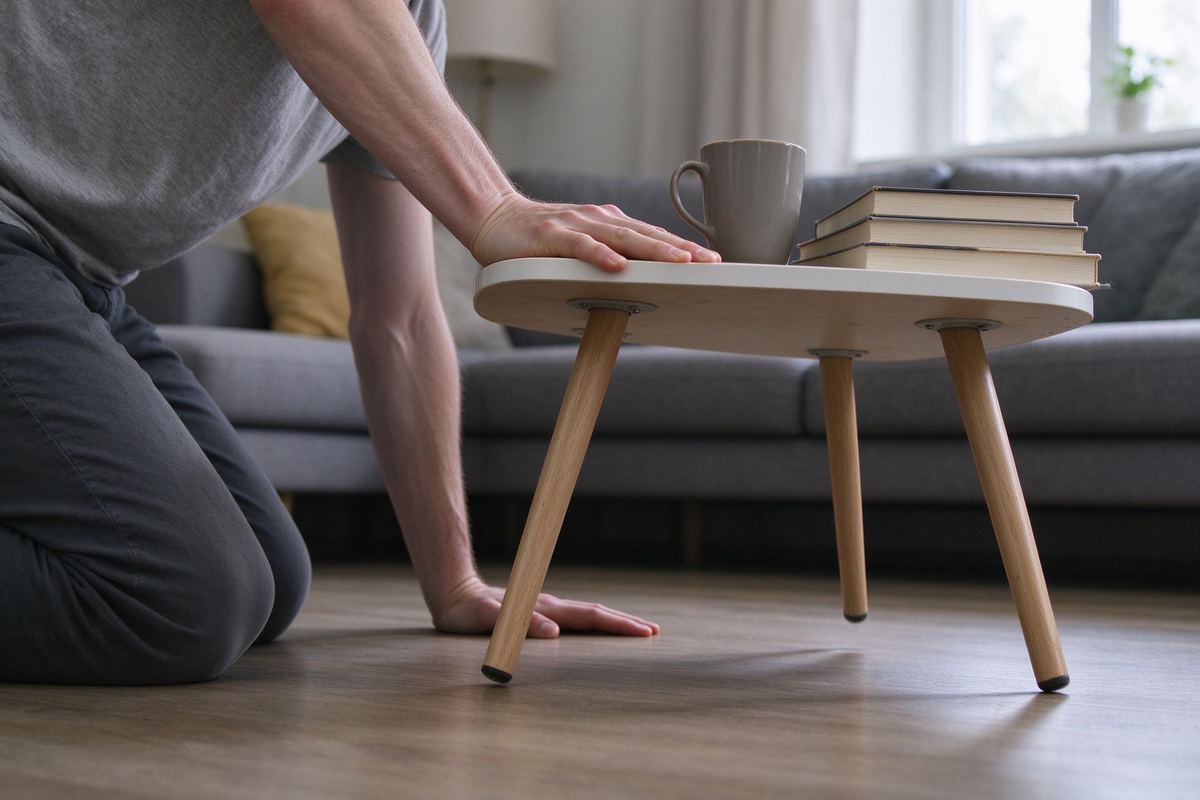
- ▪ A coffee table, a chair back and a toilet tank all move when you lean on them — and they move in the direction you least want.
- ▪ A wall grab bar is the right answer where you can drill, but not in a rented home, and not in the middle of a room.
- ▪ An electric lift chair does the lifting, and it lives where it is plugged in and charged.
- ▪ This is the plain version: something freestanding, solid and close to hand, wherever you happen to be standing up.
A bar at the height your hands are at.
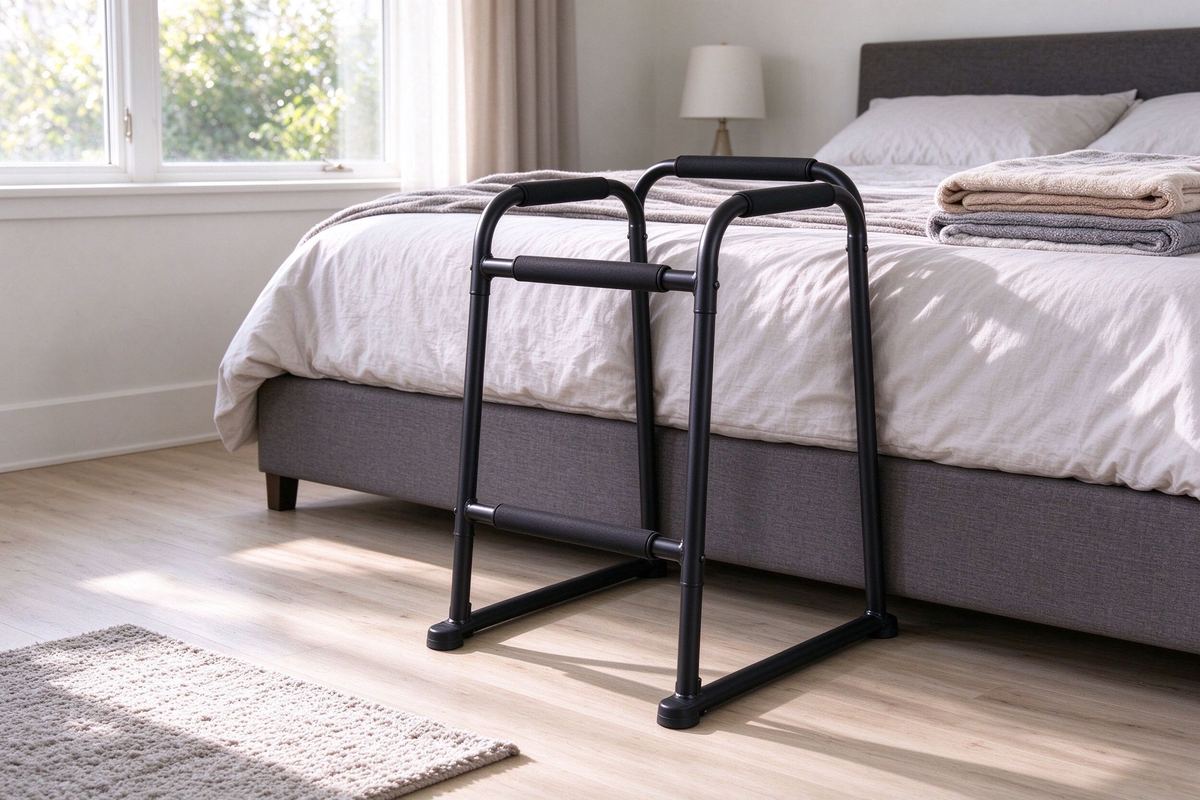
Getting up from a sofa, a bed and the floor put your hands at three different heights. The frame carries a padded grip for each one, and a wide base that does not walk away from you.
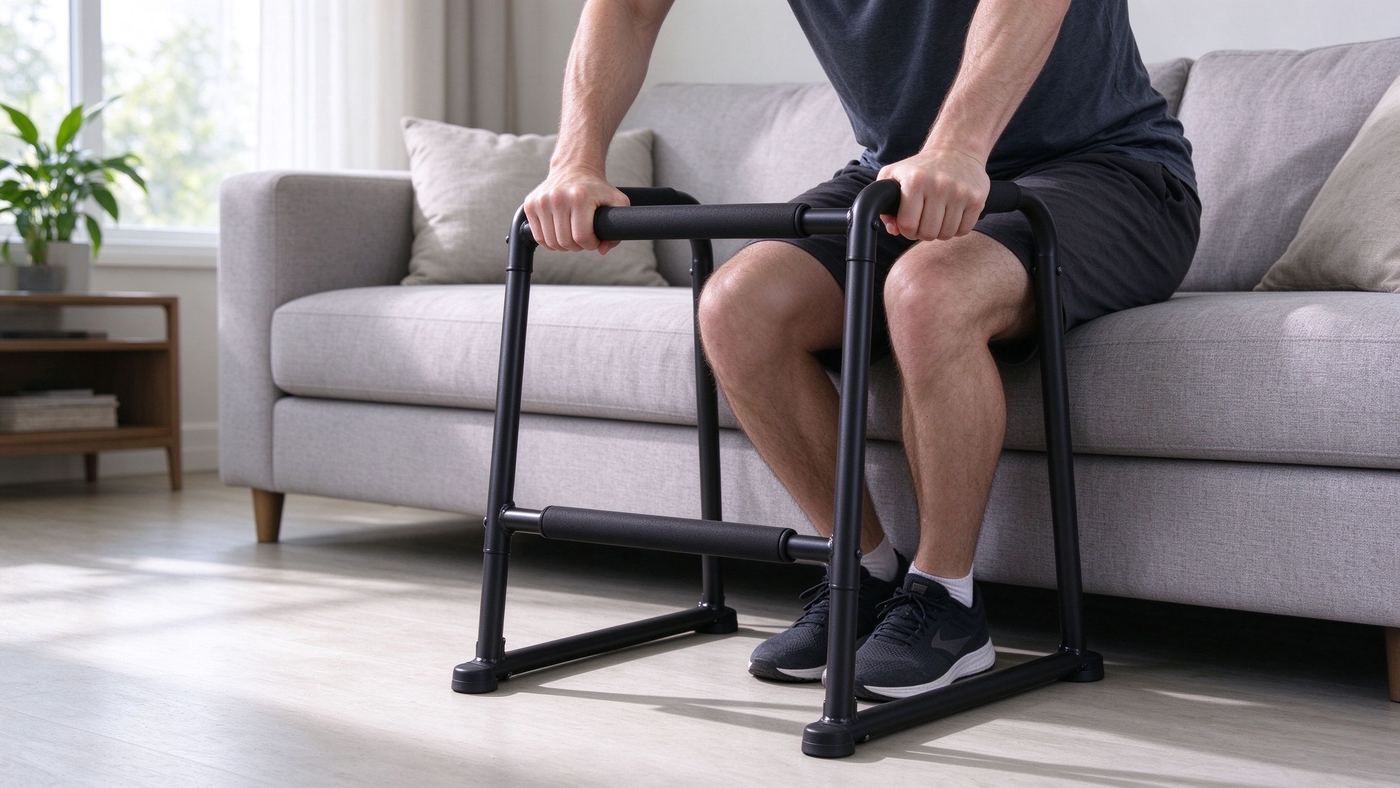
Bars sit at roughly 19.5 in (50 cm), 31 in (78 cm) and 39 in (100 cm) from the floor, so there is one within reach whether you are on the floor, on a low seat or already up.
The frame splays out to about 21–24 in (54–62 cm) wide, with a rubber foot at every corner to grip a hard floor without marking it.
It stands on the floor. No wall fixings, no landlord to ask, no battery to keep topped up.
About 7.3 lb (3.3 kg). Lift it by the top bar and it goes wherever you are going to be.
Four things that decide whether it holds.
A support handle is only useful if it stays still and feels the same every day. These are the parts that make that happen.
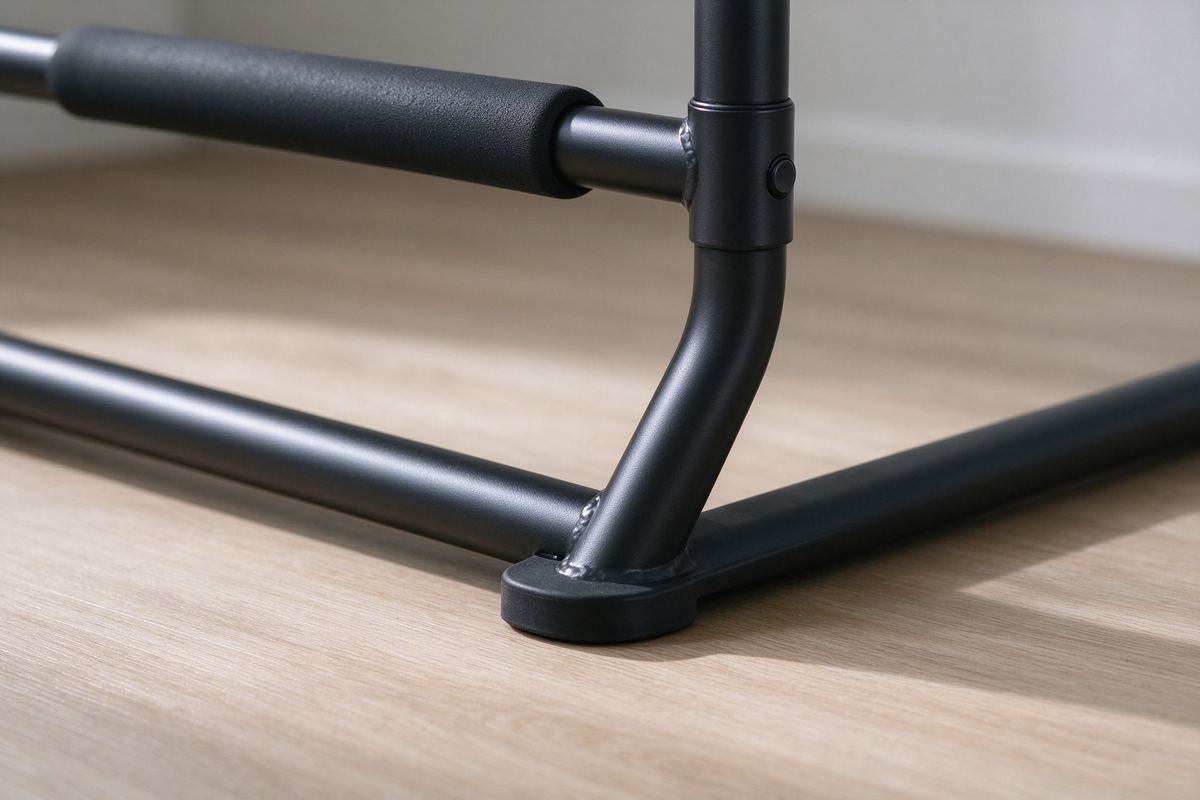
- ▪ A closed steel frame, powder-coated. Tube rather than sheet, so it does not flex when you put your weight on it, and a finish that survives being knocked about.
- ▪ Foam over every grip. Padded grips give you something to hold with dry or weak hands, and wipe clean with a damp cloth.
- ▪ Rubber feet at four corners. They grip the floor and they protect it — no metal edge ever touches a wood floor.
- ▪ Two pieces, one push-button. The upright slots into the base and clicks home; the mid grip adjusts on the same simple button-and-hole setting.
Four steps, about five minutes.
There is no installation, so the only thing that matters is where you stand it and how you check it before you lean on it.
Four feet flat on a level floor. No rug under the feet, nothing loose inside the footprint of the base.
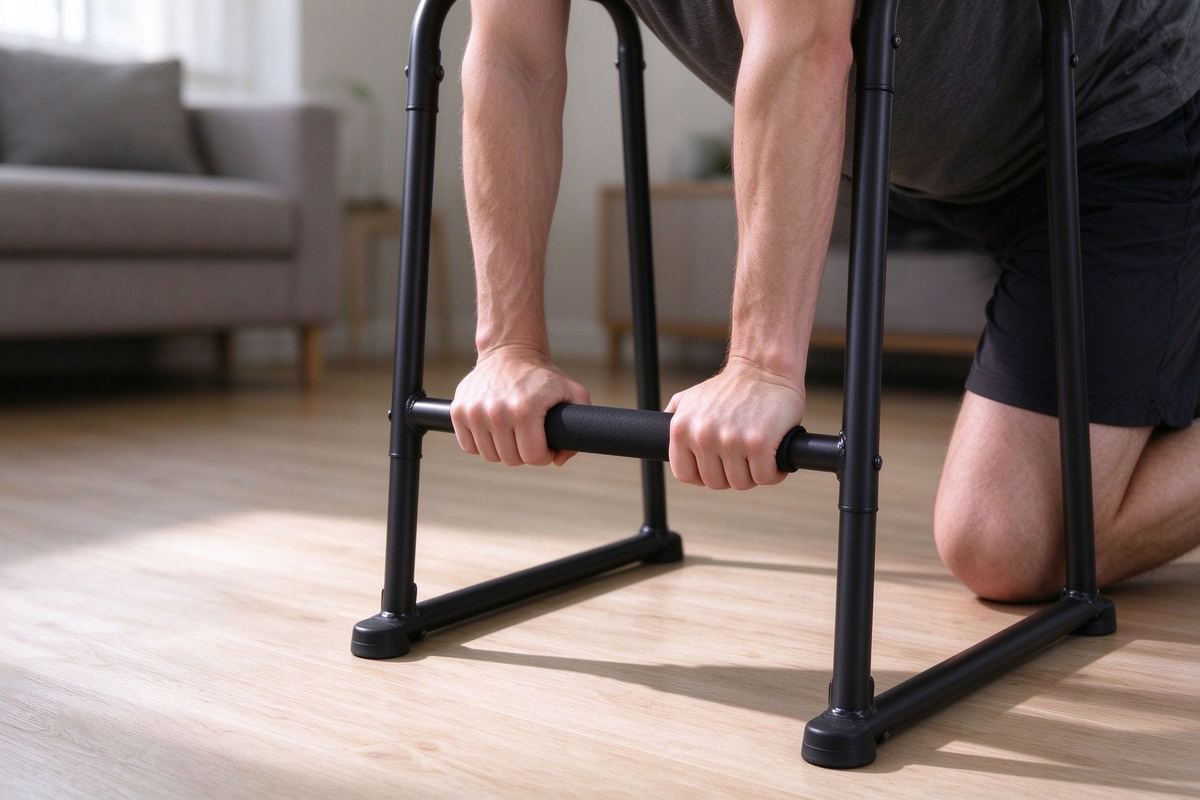
Mid bar beside a sofa or armchair, top bar beside a bed, low bar for the floor.
Push straight down on the bar with one hand. If the frame rocks or a foot slides, move it and try again.
Both hands on the bar, lean forward and drive through your legs. Keep your weight inside the four feet.
The floor decides, not the rail.
Same frame, five places. What changes is what is underneath it and which grip your hands land on.
| Where | What it needs | Grip to use |
|---|---|---|
| Beside a sofa or armchair | About 20 in (50 cm) of clear floor on the open side | Mid bar |
| Beside a bed | Clear floor on the side you get out of, rug moved away | Top bar |
| On the floor, from kneeling | Level, dry, bare floor — and someone nearby | Low bar |
| By the dining table or a commode | Frame set on the floor beside the seat, not under it | Mid bar |
| Outdoors: patio, garage | Level concrete or decking, never gravel, grass or wet tile | Mid or top bar |
Note: The rail is only as stable as the floor under it. Thick pile carpet, loose rugs, wet tile and sloped surfaces are the wrong places for it — the feet have nothing to grip, and the frame can walk out from under your hands.
Where it sits next to the other options.
Four ways to solve the same problem, and the honest version of when each one is the right tool.
| At a glance | This stand assist rail | Electric floor lift chair | Wall grab bar | Leaning on furniture |
|---|---|---|---|---|
| What it does | Gives your hands a fixed point; you stand | Raises you from the floor up to seat height | Gives your hands a fixed point | Moves under your hand, and tips |
| Power | None | Rechargeable pack, kept charged | None | None |
| Installation | Stands on the floor, no tools | Snap-together, then charged after use | Drilled into a wall or stud | None |
| Where it works | Any level, dry floor, any room | Wherever you set it down | Only where it was installed | Nowhere safely |
| Weight and portability | About 7.3 lb (3.3 kg), one hand | Around 30 lb, moved in two pieces | Fixed once up | Already in the room, and not built for it |
| Best for | Daily support wherever you are standing up | Getting up from the floor when legs alone cannot | One fixed spot, such as a shower | Nothing anyone should rely on |
Every number, in one place.
Grip heights, footprint and capacity are what decide whether this rail suits your room, so all three are listed below.
| Specification | Value |
|---|---|
| Frame | Powder-coated steel tube, closed frame |
| Grips | Three padded grips at approx. 19.5 in (50 cm), 31 in (78 cm) and 39 in (100 cm) from the floor |
| Grip padding | Closed-cell foam over the tube; wipes clean |
| Height adjustment | Mid bar adjusts in six steps, approx. 26.7–31.6 in (68–80 cm) |
| Capacity | Up to 300 lb (136 kg) static load |
| Footprint | Approx. 21–24 in wide × 19.5 in deep (54–62 × 49.5 cm) |
| Feet | Four non-slip rubber pads; floor-friendly |
| Assembly | Two pieces, tool-free, about five minutes |
| Weight | Approx. 7.3 lb (3.3 kg) |
| Finish | Matte black; wipe with a damp cloth |
| Quantity | 1 rail (base and upright) |
1 × base frame with four rubber feet
1 × upright with three padded grips
1 × setup and safety sheet
Capacity is a static load on a level, dry floor. This is a support handle, not a lifting device: it holds your hands while you stand, it does not stand you up.
If the rail is moved often, push down on each grip and check the feet before you use it.
Four rules that keep it useful.
Everything that makes this rail safe is in how it is placed and how you lean on it, so these four take a minute to read.
- ▪ It does not lift you. You stand; the rail is what your hands hold while you do it. Keep your weight inside the four feet, and never lean sideways past the outer corners.
- ▪ Level, dry, firm floor only. Hard floors, low-pile carpet on a firm underlay and level concrete are fine. Thick pile, loose rugs, wet tile, gravel, grass and slopes are not.
- ▪ It is not a step. Never stand or kneel on the frame, and never use it to climb. It is there to be held.
- ▪ Check it every month. Push down on each grip. If the frame rocks, the push-button has not locked, or a rubber foot is missing or worn, take it out of use.
No. It puts a solid, fixed grip at the height your hands are already at while you push up through your legs. It takes the balance problem out of standing up; it does not take over the work.
Up to 300 lb (136 kg) of static load on a level, dry floor. In practice the frame is rarely the limit — a rug, a wet tile or a slope is.
No. It is freestanding. Nothing is fixed, nothing is drilled, and it can be moved to another room whenever you need it there.
Low-pile carpet on a firm underlay, no. Thick pile or a loose rug, yes — in that case move the rail to a hard floor, or move the rug out of the way.
Stand it beside you on level floor, roll onto one knee, take the low bar with both hands, then push through your legs as you pull. Have someone with you the first time.
- ▪ Three padded grips at approx. 19.5, 31 and 39 in — a bar within reach whether you are on the floor or on the sofa.
- ▪ Up to 300 lb on a level, dry floor, on rubber feet that grip and protect the floor.
- ▪ No tools, no drilling, no charging: it stands on the floor and moves from room to room.
- ▪ A support handle, not a hoist — you stand, and the rail is what your hands hold.
Freestanding, three padded grips, rubber feet, no installation of any kind.



Reviews
There are no reviews yet.