

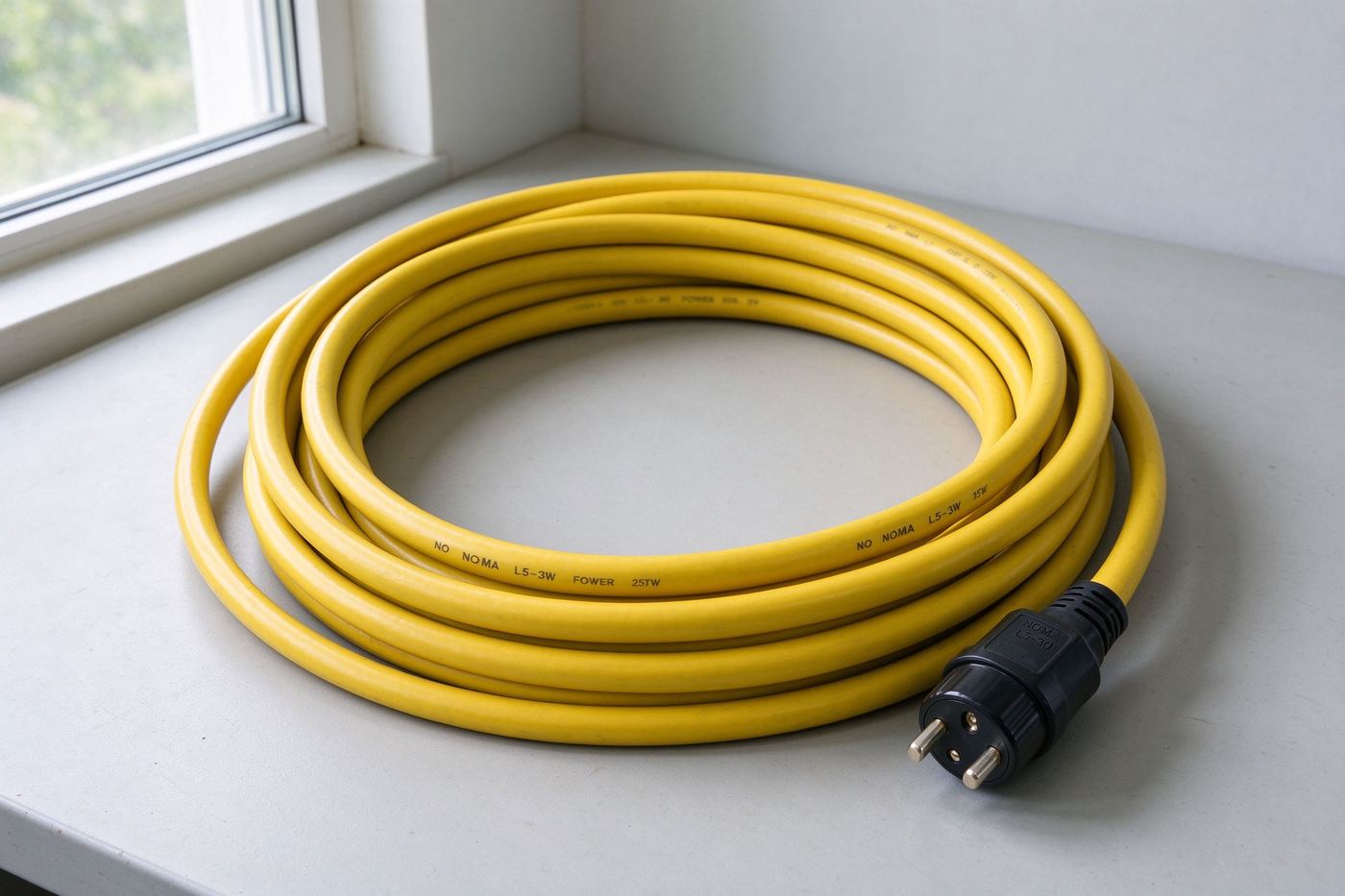
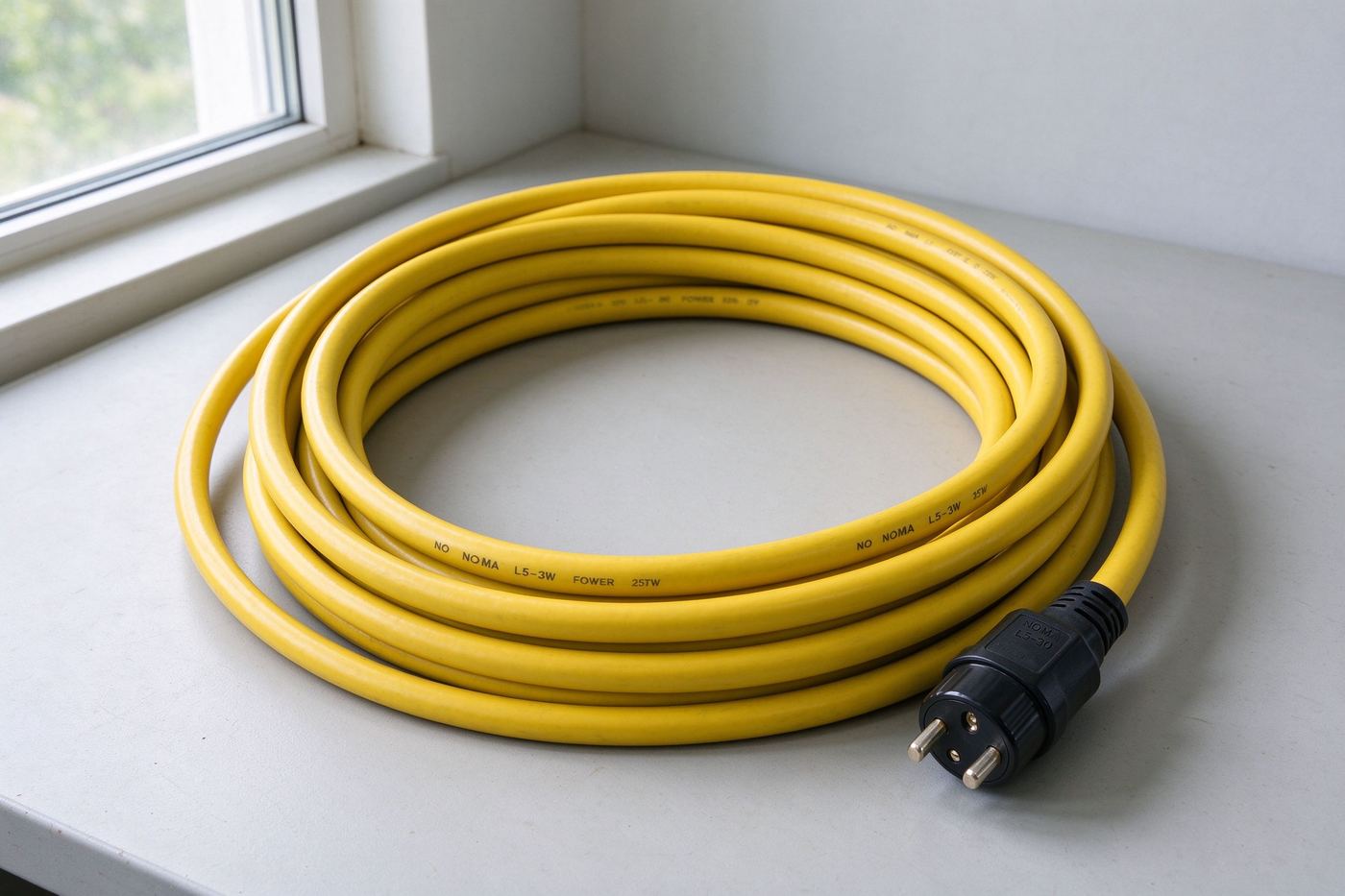
A household extension cord is not built for generator power.
Generators put out 30 amps at 125V. A regular 16-gauge extension cord is rated for 13 amps. Plug a generator into one and the cord heats up, the plug melts, and you risk a fire.
- ▪ Household cords are too thin. 16 AWG wire drops voltage over distance. At 25 feet, a 16-gauge cord on a 30A load runs hot and loses voltage under load.
- ▪ Generator cord is 10 AWG. Three 10-gauge copper conductors carry the full 30A with minimal voltage drop, even at 25 feet.
- ▪ Twist lock stops accidental disconnection. Vibration from a running generator can shake a standard plug loose. The L5-30 twist-lock ring clicks into place and stays.
- ▪ Outdoor rated means outdoor safe. SJTW jacket resists water, oil, UV and temperature swings. A household cord left outside degrades in one season.
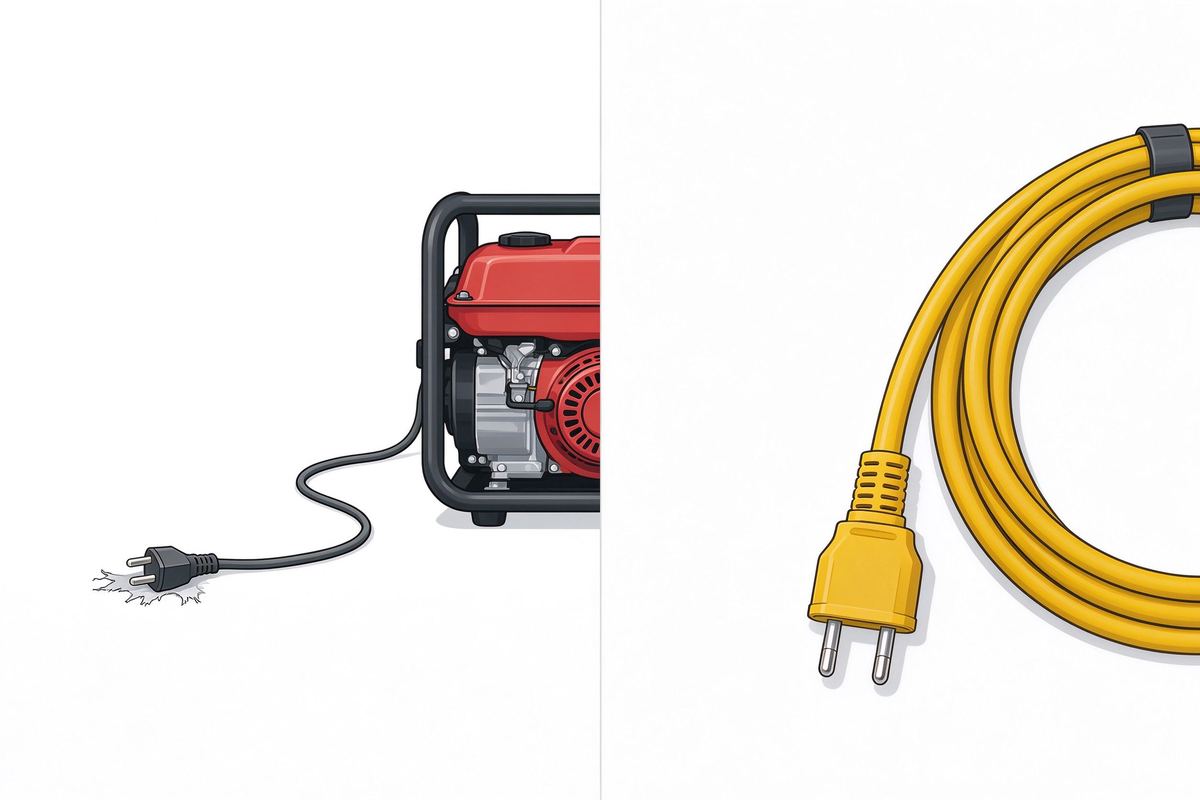
Bridge between your generator and everything you want to power.
Plug one end into the generator’s 30A outlet, the other end into your RV, a power inlet box, or a splitter. That is the whole job.
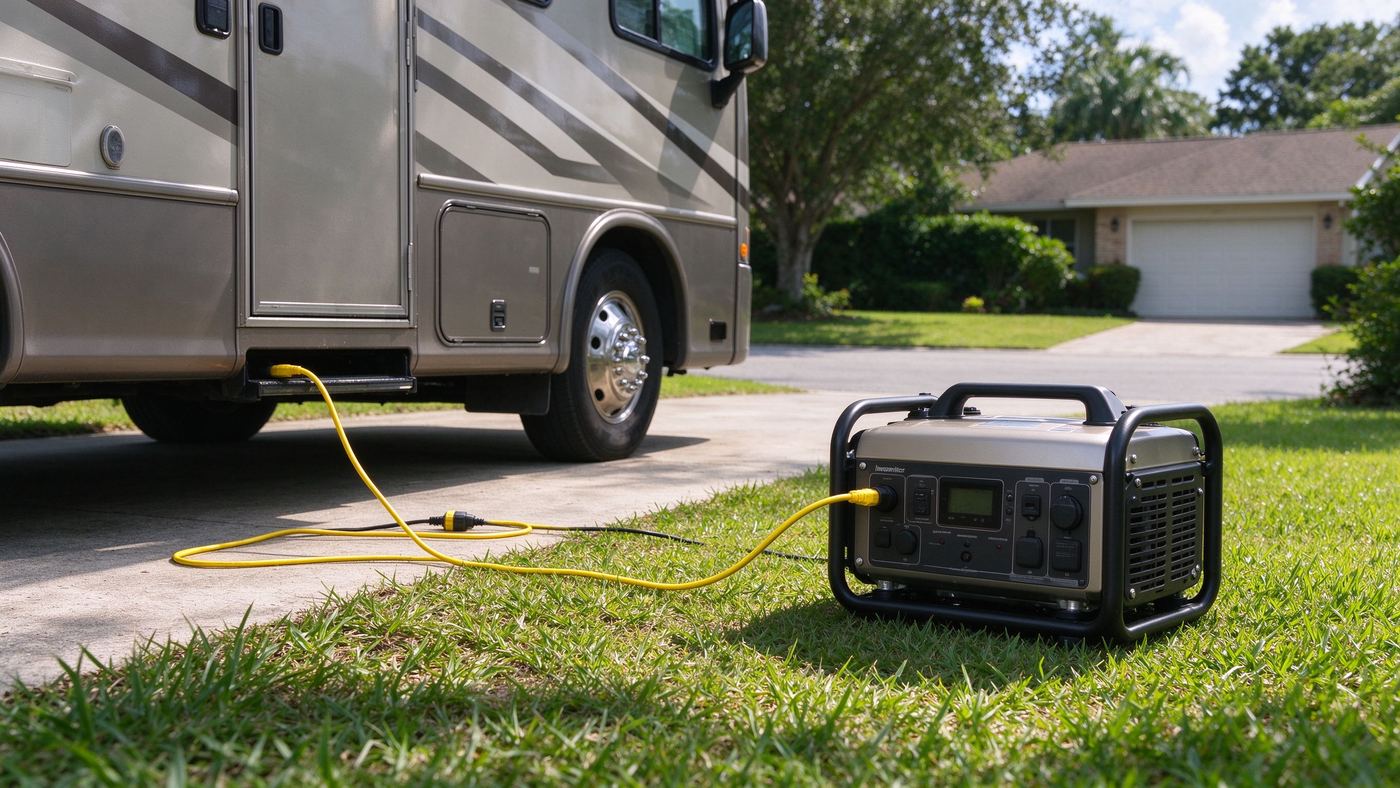
Handles the full output of a 2200 to 3500 watt inverter generator. Enough for an RV air conditioner, fridge, lights and a few small appliances at the same time.
Standard 30A 125V locking connector. Twist the ring to plug in, twist again to release. No pull-out, no accidental disconnect from vibration.
Three 10-gauge stranded copper conductors inside a thermoplastic elastomer jacket that stays flexible from -40F to 140F. Water, oil and UV resistant.
Long enough to run the generator out of the garage or away from the living area, while the RV or house stays plugged in. Coils up compactly when not in use.
The plug is what makes it safe.
Twist-lock connectors are the standard on generator outlets because they cannot shake loose under load.
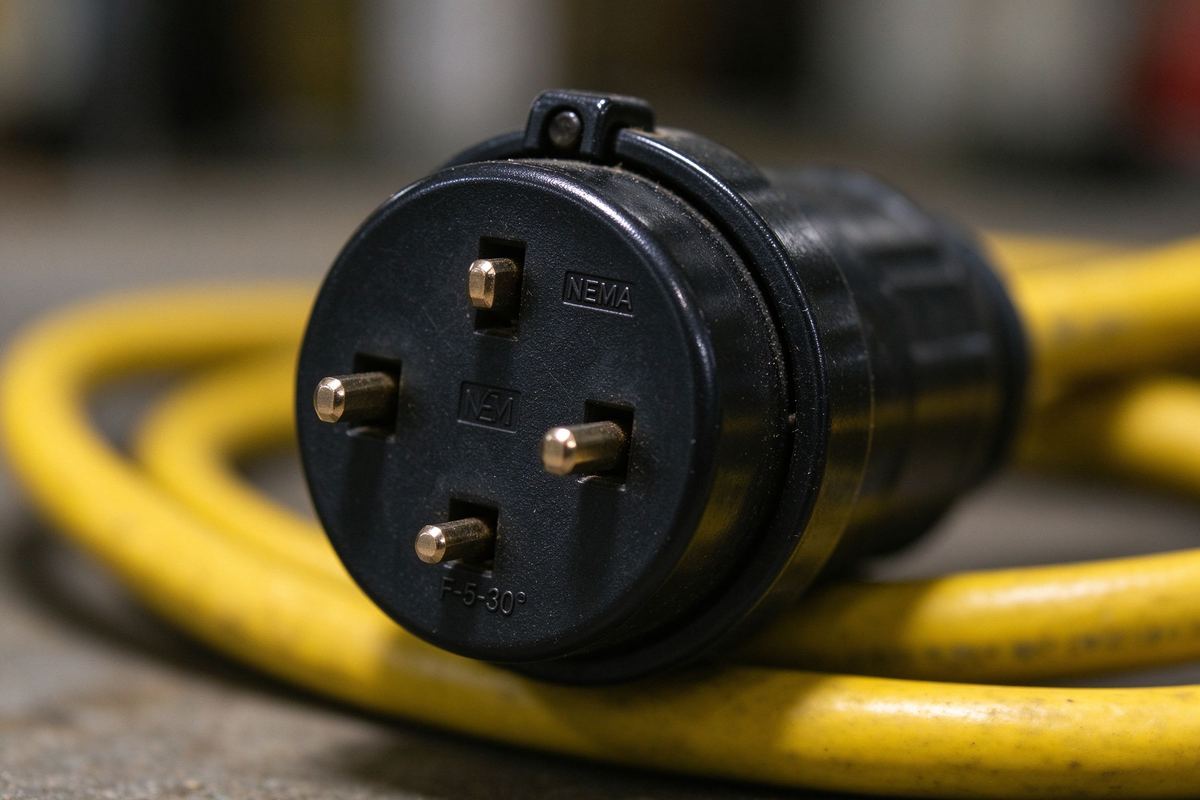
- ▪ Neoprene rubber plug housing. Stays flexible in cold weather, resists impact and abrasion. Contacts are brass for conductivity and corrosion resistance.
- ▪ Strain relief at the cord end. The cable does not bend sharply at the plug. A molded strain-relief boot keeps the wires from breaking at the connection.
- ▪ Cord jacket wipes clean. Dirt, mud, rain, oil — hose it off and roll it up. No special storage conditions needed.
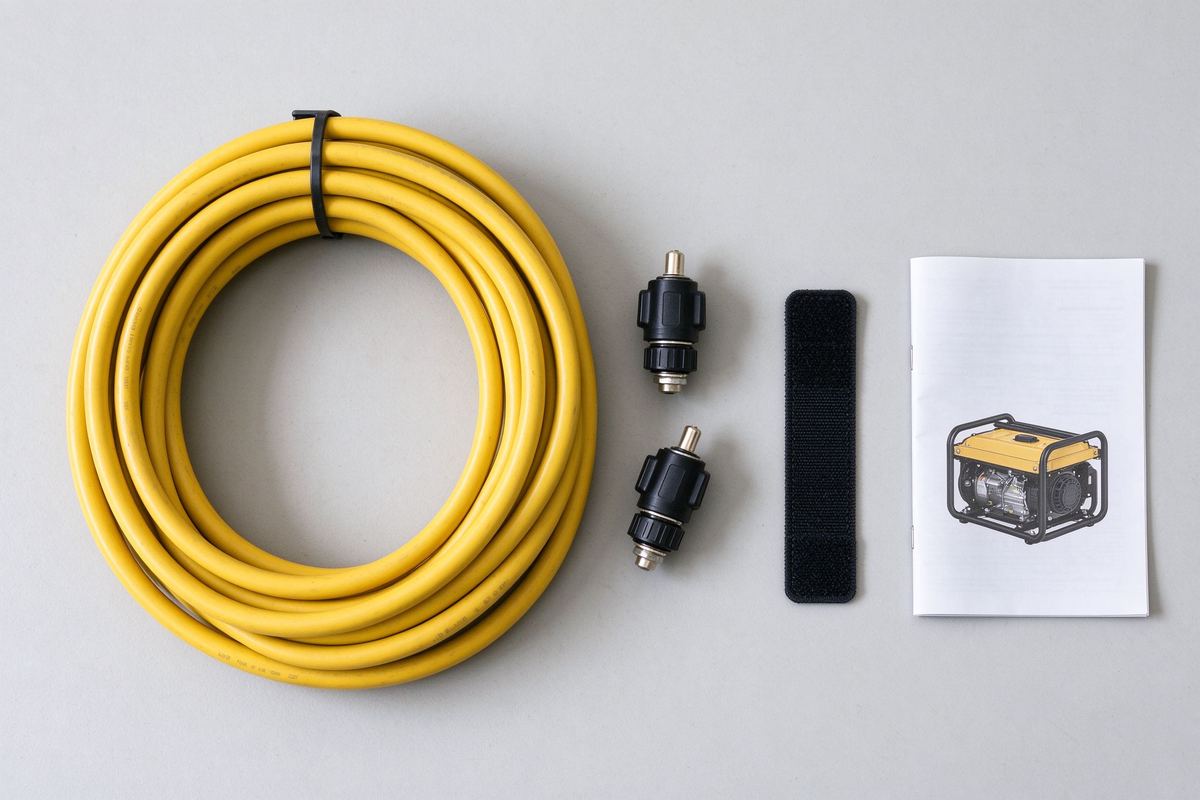
- ▪ Velcro strap included. Wrap the coiled cord to keep it tidy on the shelf or in the RV basement.
Plug in, twist, power on.
Two connections, one rule: connect the generator first, then the load. Reverse order sparks at the plug.
With the generator off, plug the L5-30P end into the generator’s 30A outlet. Twist the ring clockwise until it clicks.
Lay the cord out to the RV inlet, power inlet box or splitter. Uncoil it fully so it does not overheat. Do not run it under a rug or through a doorway.
Plug the L5-30R end into the RV inlet or inlet box. Twist to lock. Make sure the load side is off before you start the generator.
Start the generator, let it stabilize for a minute, then turn on the appliances. To disconnect: turn off the load, stop the generator, then unplug.
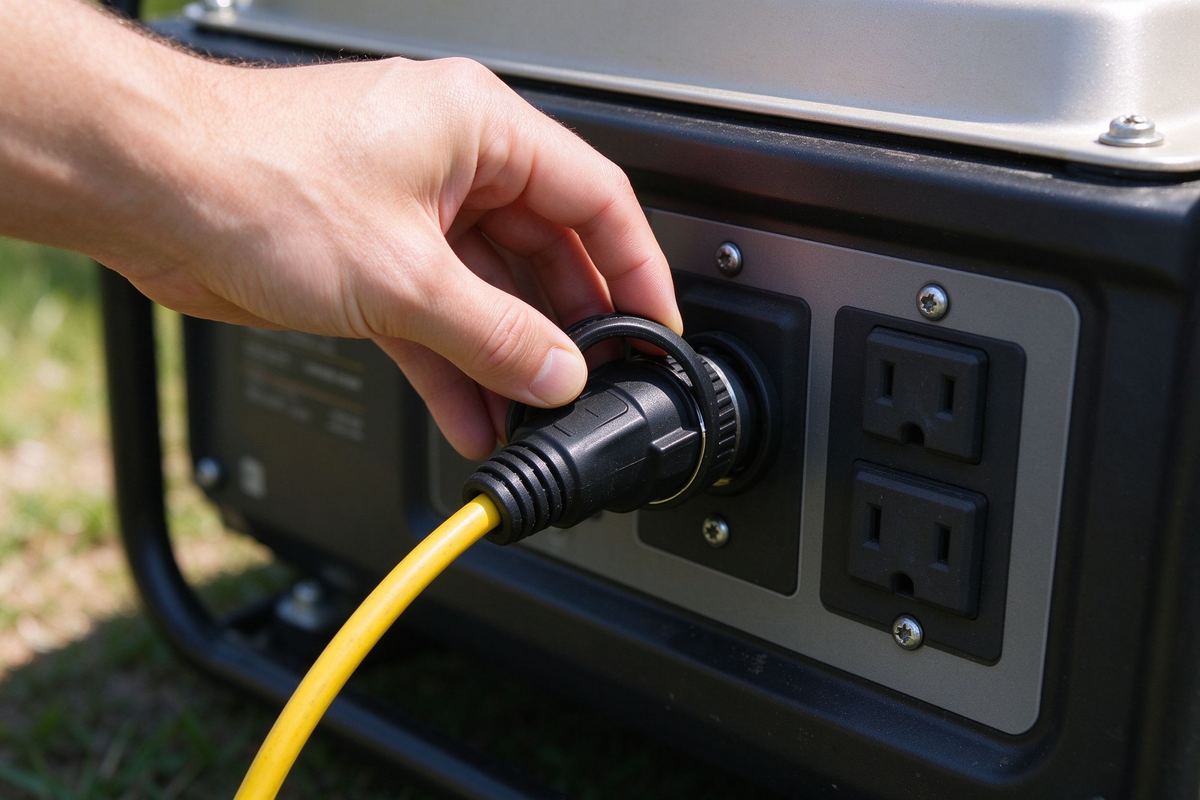
What it connects to, and what it does not.
It carries 125V 30A single-phase power. It does not step up voltage, and it does not convert 240V to 120V.
| Use it for | Fits | Note |
|---|---|---|
| RV 30A power inlet | Any RV with a 30A shore power inlet | Most travel trailers and smaller motorhomes. Plug the cord into the RV shore power and the generator on the other end. |
| Home backup inlet box | 30A exterior power inlet boxes | Transfer-switch inlet boxes on the side of a house. Always use with a transfer switch, never backfeed through a wall outlet. |
| Jobsite and event power | Splitter boxes, stage lighting, food trucks | Run the generator out of the way, then power tools or equipment from the other end. |
| 240V appliances or dryer outlets | — | This cord is 125V only. It does not carry 240V. Do not try to adapt it to a NEMA 14-30 or 14-50 dryer outlet. |
| Indoor extension for lamps | — | It is outdoor rated, but it is a heavy 10-gauge cord. For indoor use, keep it clear of walkways and doorways. |
Note: Never backfeed a house through a wall outlet. Use a listed power inlet box with a transfer switch. Backfeeding through a wall outlet can electrocute a lineman working on the line.
Three ways to get generator power to where you need it.
Same generator, same distance, and the real difference in safety and capacity.
| At a glance | This 30A twist-lock cord | Household extension cord | Smaller 15A generator cord | Direct wire hardwired |
|---|---|---|---|---|
| Capacity | 30A, up to 3750W | 13-15A, up to 1875W | 15A, up to 1875W | Depends on wire |
| Voltage drop at 25 ft | Minimal, 10 AWG conductors | Significant, 16 AWG overheats | Moderate, 14 AWG | None |
| Disconnect safety | Twist lock, cannot shake loose | Can pull out or vibrate loose | Can pull out | N/A, hardwired |
| Best for | Inverter generators, RVs, backup power | Lamps and small tools | Small 15A generators | Permanent install |
| Setup time | Seconds, plug and twist | Seconds, but unsafe for generator load | Seconds, limited capacity | Hours, requires an electrician |
What you get, in plain numbers.
Current rating, conductor size, connector type, and the materials built in.
| Specification | Value |
|---|---|
| Current rating | 30A at 125V AC |
| Max power | 3750 watts |
| Length | 25 feet (approx. 7.6 m) |
| Conductors | 3 x 10 AWG stranded copper, SJTW jacket |
| Connectors | NEMA L5-30P plug to NEMA L5-30R connector, twist lock |
| Cord jacket | SJTW thermoplastic elastomer, weather, oil and UV resistant |
| Temperature range | Approx. -40F to 140F (-40C to 60C) |
| Color | Yellow jacket, black plugs |
| Includes | Velcro strap for coiling |
25 foot 30A generator power cord with L5-30 twist-lock connectors on both ends, plus a velcro storage strap.
This is a 125V single-phase cord. It does not carry 240V. Use it with listed power inlet boxes and transfer switches. Never backfeed a wall outlet. Do not overload the cord beyond 30A continuous.
Four rules that keep generator power safe.
Generator electricity is not a toy. The cord is the safe bridge, but only if you use it the right way.
- ▪ Never backfeed through a wall outlet. Plugging a generator into a household wall outlet sends power back through the lines to the neighborhood, and can kill a lineman.
- ▪ Uncoil fully under load. A coiled cord acts like an inductor and heats up. Lay the whole 25 feet out before you plug in a heavy load.
- ▪ Keep the generator outside. Carbon monoxide kills. The cord lets you run the generator outside, away from living spaces. Do not run it in the garage.
- ▪ Inspect before every use. Cracked jacket, loose plugs, discolored contacts — stop using the cord if you see any of these. A frayed 30A cord is a fire waiting to happen.
Yes, if your generator has a 30A 125V twist-lock outlet (usually labeled L5-30R). Most 2200 to 3500 watt inverter generators have one. Check your generator’s outlet panel.
Not recommended. Each connection adds resistance and a failure point. For longer runs, get a single longer cord. Daisy-chaining also voids the rating.
The SJTW jacket is water resistant and rated for outdoor use in rain. Do not submerge it. Wipe it dry before coiling and storing.
Yes, if your transfer switch inlet box has an L5-30R inlet. This cord plugs directly into the inlet box on one end and the generator on the other.
L5-30 is 30A, L5-20 is 20A. They look similar but the pin spacing is different. This cord is L5-30, the standard for 2200 to 3500 watt inverter generators.
- ▪ 30A 125V generator power cord, 25 feet long, NEMA L5-30 twist-lock connectors on both ends.
- ▪ SJTW 10/3 cord, weather and oil resistant, stays flexible in cold weather.
- ▪ Carries up to 3750 watts, enough for an RV, backup power or jobsite tools.
- ▪ Twist lock prevents accidental disconnection from generator vibration.
25 foot 30A 125V generator power cord, L5-30 twist lock, SJTW 10/3 weatherproof jacket.




Reviews
There are no reviews yet.